Shrinkable soils are a common but often underestimated risk in construction projects across the UK. For project managers, architects, quantity surveyors, planners, contractors and clients, understanding how these soils behave and how to design safely on them is essential to avoiding long-term structural damage, costly remedial works, and disputes.
This article explains what shrinkable soils are, why they pose a risk to buildings, and how foundation design can be adapted to manage those risks effectively. Drawing directly on recognised technical guidance, it provides practical, regulation-aligned insights to support informed decision-making during design and construction.
What Are Shrinkable Soils?
Shrinkable soils are cohesive soils, most commonly clays, that change volume depending on their moisture content. When moisture is lost, the soil shrinks; when moisture is gained, it expands or swells. These volume changes can cause significant ground movement beneath buildings or to the rear of retaining structures, leading to structural distress.
The behaviour of shrinkable soils becomes particularly problematic when moisture levels fluctuate unevenly across a site. This often occurs due to environmental factors such as prolonged dry weather, leaking drains, or vegetation extracting water from the ground.
For construction professionals, the key issue is that shrinkable soils do not behave consistently over time. A building that appears stable at completion may become vulnerable years later as site conditions change.
Why Shrinkable Soils Cause Structural Damage
Buildings founded on shrinkable soils are primarily affected in two ways: subsidence and heave.
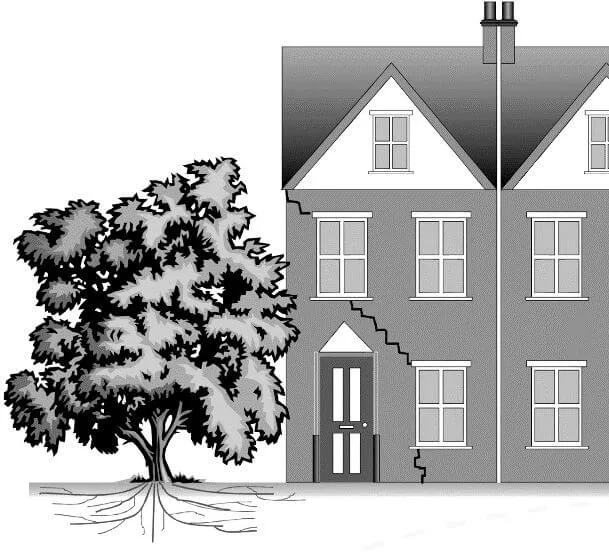
Subsidence
Subsidence occurs when soil loses moisture and shrinks and reducing its volume. This commonly results in:
- Downward movement of foundations
- Cracking, bulging, leaning to walls and fininshes
- Cracking, sloping, dropping and unevenness to floors
- Distortion of doors, windows, and services
Subsidence is frequently associated with trees and large shrubs extracting moisture from the soil, particularly during dry periods.
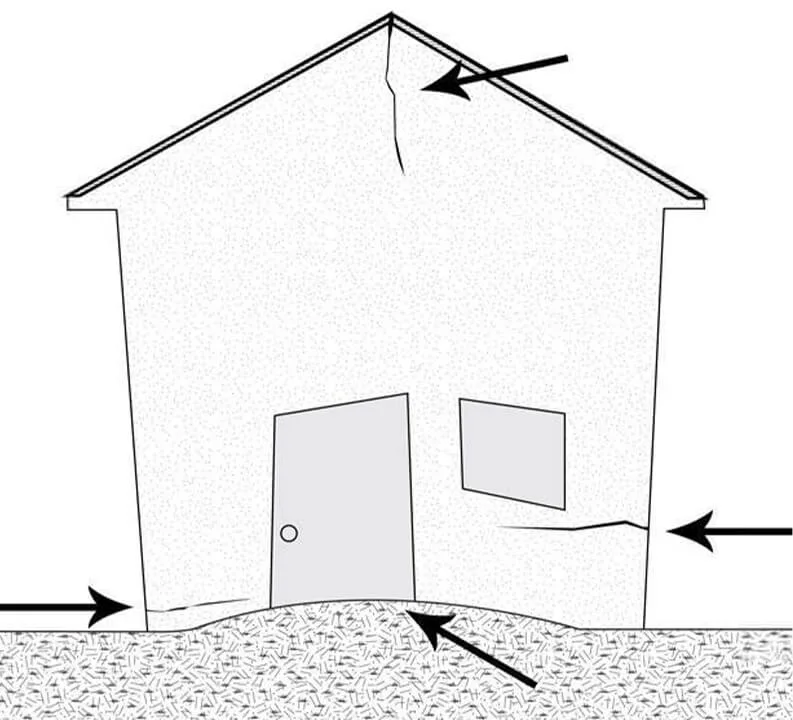
Heave
Heave is effectively the reverse process. When moisture levels increase, often after trees are removed or die, or due to water escaping from leaking drains, the soil swells, pushing foundations and floor slabs upward. This can lead to:
- Upward movement of foundations
- Cracking, bulging, leaning to walls and finishes
- Cracking, sloping, uplift and unevenness to floors
- Distortion of doors, windows, and services
Both mechanisms can occur on the same site at different times during a building’s lifespan, making shrinkable soils a long-term design consideration rather than a short-term construction issue.
Although the categories of defects are similar for both effects, the pattern and nature of theses effects are very different.
The Influence of Trees and Vegetation
Trees, hedgerows, and shrubs are among the most significant external influences on shrinkable soils. While beneficial for the environment and site aesthetics, vegetation can dramatically alter soil moisture content.
When trees are present, they extract water from the ground through their root systems. This can cause shrinkage and subsidence. Conversely, when trees are removed, moisture extraction ceases, allowing the soil to rehydrate and expand.
From a risk management perspective, designers must consider not only existing vegetation but also what might reasonably be planted or removed in the future. A building that is safe today may be damaged tomorrow or in many years if these factors are ignored.
Key Factors Affecting Shrinkable Soil Behaviour
Several interrelated factors determine how severely a building may be affected by shrinkable soils.
Tree Species and Water Demand
Different tree species have different water demands, commonly classified as low, medium, or high. Species with higher mature heights and greater water demand have a more pronounced effect on soil moisture levels and, therefore, on ground movement.
Proximity of Trees to the Building
The closer a tree is to a structure, the greater its influence. Roots can extend considerable distances, meaning even trees outside the immediate footprint of a building can still pose a risk. The effect of moisture extraction by the tree can extend even further. Commonly, trees can ultimately exert an influence on soil moisture levels of between 0.5 to 1.25 x their mature height.
Soil Volume Change Potential
The susceptibility of soil to moisture-related volume change is known as its Volume Change Potential. This depends largely on the proportion of fine particles in the soil and is determined using laboratory testing, such as the Atterberg Limits test.
| Plasticity index (%) | Soil Type | Degree of Plasticity | Degree of Cohesiveness |
|---|---|---|---|
|
0% |
Sand |
Non-plastic |
Non-cohesive |
|
<7% |
Silt |
Low plastic |
Partly cohesive |
|
7–17% |
Silt clay |
Medium plastic |
Cohesive |
|
17% |
Clay |
High plastic |
Cohesive |
Soils are typically classified as having low, medium, or high volume change potential based on their Modified Plasticity Index.
Foundation Depth
Foundation depth plays a critical role in mitigating shrinkable soil effects. As depth increases, the influence of surface moisture changes and tree root activity generally decreases. Deeper foundations can therefore reduce, but not always eliminate, the risk of movement.
Designing Foundations for Shrinkable Soils
Effective design on shrinkable soils relies on understanding the site conditions and adopting proportionate, regulation-compliant solutions.
When No Trees Are Present
If no trees or significant vegetation are present at the time of construction, precautions are still necessary. Future planting or landscaping changes could introduce new risks.
Building Regulation Approved Document A, Section 2E4 recommends minimum foundation depths where planting is outside of the tree’s zone of influence, based on soil volume change potential:
- Low Shrinkage Soils: 0.75m
- Medium Shrinkage Soils: 0.90m
- High Shrinkage Soils: 1.00m
NHBC Standards Chapter 4.3 – Building Near Trees, Table 4 recommends minimum foundation depths allowing for restricted new planting, based on soil volume change potential:
- Low Shrinkage Soils: 1.00m
- Medium Shrinkage Soils: 1.25m
- High Shrinkage Soils: 1.50m
Where soil data is unavailable, the best practice is to assume high shrinkage conditions and high water demand vegetation. While conservative, this approach protects the building over its full design life.
Additional design strategies may include:
- Trench fill or strip foundations with increased depth
- Pier and beam or pile and beam systems
- Suspended ground floors to isolate the structure from ground movement
- Stiff raft foundations with granular infill to replace sensitive soil
These options help accommodate potential soil shrinkage without transferring excessive movement into the superstructure.
When Trees Are Present
If trees are present near the proposed building, heave precautions become essential. Removing trees without suitable design measures can cause severe upward movement of the soil.
Common approaches include:
Trench Fill Foundations
Foundations are extended down to soils, at greater depth, which are not affected significantly by changes in moisture content. This may be to depths of up to 2.5m or, subject to an Engineer’s design, even deeper. These foundations would then support walls and, typically, suspended ground floors.
Pier and Beam or Pile and Beam Foundations
Isolated concrete piers or piles are extended down to soils at greater depth, which are not affected significantly by changes in moisture content. Beams are then constructed between the piers or piles to support the walls and typically, suspended ground floors.
Suspended Ground Floor Slabs with Void Formers
This method allows the soil to expand into a void beneath the floor without exerting pressure on the structure.
Rigid Raft Foundations with Granular Infill Replacement
A rigid raft distributes loads evenly and, when combined with compressible or granular infill to replace sensitive soil, can accommodate limited heave. Typical depths for this approach may reach 2.50 m, depending on site conditions.
Regulatory guidance also notes that where information on soil properties or vegetation is incomplete, the most onerous assumptions should be made. While this can increase initial construction costs, it significantly reduces long-term risk.
Practical Implications for Construction Management
For construction professionals, shrinkable soils affect more than just foundation design. They have implications for:
- Programme planning due to deeper excavations and specialist foundation systems
- Cost control particularly where conservative assumptions are required
- Risk management including future liability for structural movement
- Coordination with landscaping and drainage design to control moisture changes
Early site investigation and clear communication between designers, contractors, and clients are essential. Decisions made at the concept or planning stage can prevent major issues years after project completion.
Managing Shrinkable Soil Risk Effectively
Building on shrinkable soils demands a proactive, informed approach. The risks of subsidence and heave are well understood, but they remain a common cause of structural damage when not properly addressed.
By understanding soil behaviour, accounting for vegetation effects, and adopting appropriate foundation strategies, construction professionals can deliver buildings that remain stable throughout their lifespan. Where uncertainty exists, conservative design assumptions and proven heave precautions provide a reliable safeguard.
Ultimately, successful projects on shrinkable soils are those where geotechnical understanding, regulatory compliance, and practical construction knowledge come together early in the design process, protecting both the structure and the professionals responsible for delivering it.