


You’ve designed a substation to the flood protection standard you know works, submitted it, and then discovered the DNO in that region expects something entirely different. Now you’re facing a redesign, a delayed programme, and an awkward conversation with the client. If that scenario sounds familiar, you’re not alone, and the root cause is rarely poor engineering. It’s the fact that every Distribution Network Operator in the UK sets its own flood protection requirements, and they don’t agree.
At Matrix Consulting Engineers, we spend a lot of time helping project teams bridge that gap. This article sets out, in plain terms, how flood protection expectations vary between the major DNOs, why those differences exist, and what they mean for the way you approach substation design.
Why Substation Flood Protection Is Not a One-Size-Fits-All Problem
A substation is a critical piece of infrastructure. Whether it’s an 11 kV local distribution site or a 132 kV bulk supply point, flooding can cause catastrophic damage, extended outages, and serious safety risks. That’s why flood risk sits near the top of every DNO’s design agenda.
The complication is that the UK electricity distribution network is carved up between regional operators. Each has developed its own technical specifications, informed by its own network history, geography, and asset management philosophy. What UK Power Networks (UKPN) accepts in the South East is not necessarily what Scottish and Southern Electricity Networks (SSEN) or SP Energy Networks (SPEN) will accept in their territories.
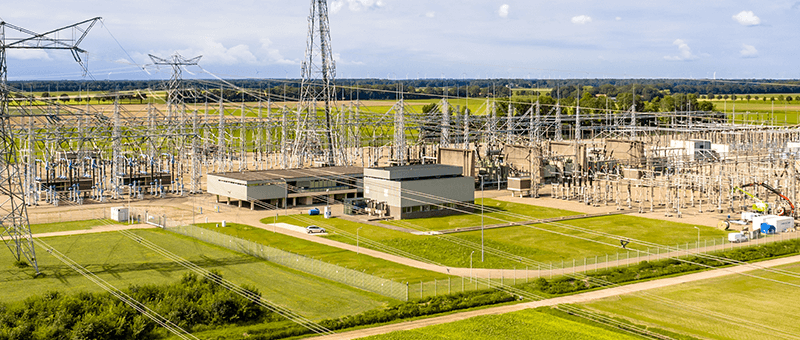
For a project manager or design engineer working across multiple regions, this creates a genuine headache. The same AIS structures (Air Insulated Switchgear arrangements, the outdoor equipment you see behind palisade fencing) might need a raised platform in one DNO area and a full perimeter flood defence in another.
The Regulatory Backdrop
Before we get into the DNO-specific detail, it’s worth noting that all of this sits on top of national planning policy. The National Planning Policy Framework (NPPF) and the Environment Agency’s flood risk guidance still apply. Substations are typically classed as essential infrastructure, which means they can sometimes be permitted in higher-risk flood zones, but only with robust mitigation.
So you’re effectively designing to two layers of requirement at once: the national planning framework and the specific DNO’s engineering standard. When those two layers pull in slightly different directions, the DNO standard usually governs the physical design.
Comparing the Major DNO Approaches to Flood Protection
Here’s the concise comparison the brief calls for. The important caveat first: DNO standards are updated regularly, and site-specific derogations are common. The summary below reflects the general design philosophies we encounter, not a substitute for checking the live specification for your project.
The Core Difference: Design Flood Level and Freeboard
The single biggest variable between DNOs is how they define the design flood level and how much freeboard (the safety margin above the predicted flood level) they demand. This one decision cascades through the entire civil and structural design.
| DNO | Typical Flood Design Philosophy | Common Design Response |
|---|---|---|
| UKPN | Emphasis on elevating critical equipment above a defined flood level with generous freeboard, often expects assessment against a 1 in 1000 year event for key assets | Raised plinths, elevated platforms, equipment mounted clear of flood level |
| SSEN | Focus on keeping water out via defences and drainage, with attention to climate change allowances across large rural and coastal catchments | Perimeter flood barriers, robust site drainage, resilience measures |
| SPEN | Combined approach balancing site raising and defensive measures, strong emphasis on maintaining safe access during a flood event | Platform raising plus access route design and pumped drainage |
| National Grid | Applies to transmission-level assets (132 kV and above at the interface), typically the most stringent, treating substations as nationally critical | Comprehensive defence, redundancy, and long design return periods |
The key takeaway: UKPN tends to favour raising equipment out of the water, while SSEN leans toward keeping the water out. SPEN often blends both, and National Grid applies the most conservative standards because of the strategic importance of transmission assets. These are tendencies, not rigid rules, but they explain why a single design rarely transfers cleanly between regions.
Illustrative Diagram: Three Ways to Solve the Same Flood
Below is a conceptual layout your design team can use as a discussion starter. (For the published version, we recommend a simple cross-section illustration rendered by the design team.)

The point of the diagram is simple: the same flood threat can be answered in fundamentally different ways, and the DNO decides which answer is acceptable on their network.
What These Differences Actually Mean for Your Design
Once you understand which philosophy a DNO follows, the downstream design decisions become far more predictable. Here’s where those differences bite.
Foundation and Structural Design
If you’re raising equipment (Approach A), your foundation design has to carry elevated loads at height, and your structural analysis must account for the platform structure, access, and wind loading on raised assets. A transformer bund (the containment wall that catches oil spills) then has to be integrated with the raised arrangement rather than sitting flat on the ground.
If you’re defending the site (Approach B), the flood barrier itself becomes a load-bearing structure that must resist hydrostatic pressure. Your site investigations need to confirm ground conditions can support that defence and resist any uplift or scour.
Drainage Design
Keeping water out only works if you can also get water off the site once it’s inside the defence line, from rainfall, overtopping, or seepage. That’s why drainage design and pumped systems become central to the SSEN and SPEN-style approaches. A sealed site with no drainage strategy is a bathtub waiting to fill.
Access and Operations
Asset managers and operations directors, this one’s for you. Several DNOs, SPEN in particular, place real weight on maintaining safe operational access during a flood. A substation that survives the flood but can’t be reached or operated safely for a week hasn’t actually met the resilience objective. This often drives highway design and access road levels as much as the substation platform itself.
How Matrix Approaches Multi-DNO Substation Projects
We’ve learned that the cheapest way to save time on these projects is to get the flood strategy right before the layout is fixed, not after. Our process reflects that.
- Confirm the governing standard first. We identify the specific DNO, the exact version of their design specification, and any local derogations before we commit to a concept. This avoids designing to an outdated or wrong standard.
- Establish the design flood level early. We work from Environment Agency data, site-specific flood modelling where needed, and the DNO's climate change allowance to fix the level everything else references.
- Choose the right philosophy for the site. Sometimes raising is cheaper; sometimes defending is the only viable option due to space or ground conditions. We test the options rather than defaulting to a habit.
- Integrate civil, structural, and drainage from day one. The bund, foundations, platform, and drainage are designed as one system, not stitched together later.
- Document the compliance trail. We make it easy to demonstrate to the DNO and the planning authority exactly how the design meets their requirements, which smooths the approval process.
We’re also honest about the limits. Where a site’s flood risk is genuinely borderline or the DNO’s position is ambiguous, we’ll say so, and we’ll recommend the flood modelling or DNO liaison needed to resolve it rather than guessing.
Practical Checklist Before You Start Designing
Use this as a quick sense-check at project kick-off. If you can’t answer these, you’re not ready to fix the layout yet.
- Which DNO governs this site, and which version of their flood specification applies?
- What is the confirmed design flood level, including climate change allowance?
- What freeboard does the DNO require above that level?
- Does the DNO favour raising, defending, or a combined approach here?
- Have you checked the national planning flood zone classification alongside the DNO standard?
- Is safe operational access during a flood a stated requirement?
- Where does the transformer bund sit relative to the flood strategy?
- Is there a drainage or pumping strategy for water that gets past the primary defence?
Frequently Asked Questions
Why don't all UK DNOs use the same flood protection standard?
Because the network was historically built and maintained by separate regional operators, each developed its own engineering specifications based on its geography, asset history, and risk appetite. There’s no single mandated flood design standard that overrides them all, so regional differences persist even though the underlying flood science is the same.
Does the flood protection requirement change between 11 kV, 33 kV, and 132 kV substations?
Generally yes. Higher voltage substations are more critical to the network, so DNOs typically apply more stringent flood protection and longer design return periods as voltage and strategic importance increase. A 132 kV bulk supply point will usually face tougher requirements than a local 11 kV distribution substation.
Can a substation be built in a high flood risk zone at all?
Often, yes. Substations are usually classified as essential infrastructure under national planning policy, which can permit them in higher-risk zones, but only with a robust flood risk assessment and appropriate mitigation. The DNO’s own standard then dictates the specific engineering measures required.
What is a transformer bund and how does flood protection affect it?
A transformer bund is a containment structure designed to catch oil in the event of a transformer leak or failure, preventing environmental contamination. When flood protection is involved, the bund must be integrated with the wider flood strategy, so it functions correctly whether the equipment sits at grade behind a barrier or is raised on a plinth.
How early should flood protection be considered in substation design?
At the very start. The design flood level and the chosen protection philosophy influence foundations, platform levels, drainage, access roads, and the bund. Retrofitting flood protection after the layout is fixed is the single most common cause of costly redesign we see.
What to Look for in an Engineering Consultant on Flood-Sensitive Substations
If you’re appointing a consultant for a substation project, the flood question is a good litmus test of their experience. Look for a team that asks which DNO and which specification version before quoting a solution, rather than one that offers a standard detail regardless of region. That single question tells you whether they’ve genuinely worked across UKPN, SSEN, SPEN, and National Grid requirements or are applying a one-size-fits-all approach.
You also want a consultant who integrates civil engineering, drainage design, and structural analysis under one roof, because flood protection sits precisely at the intersection of those disciplines. Fragmented design is where errors and coordination gaps creep in.
Finally, look for honesty about uncertainty. A good adviser will tell you when a site needs proper flood modelling or DNO liaison to resolve an ambiguity, rather than pressing ahead and hoping the approval lands.
Talk to Matrix About Your Next Substation Project
Substation flood protection is one of those areas where a small amount of upfront clarity saves an enormous amount of downstream rework. If you’re planning a project across one or more DNO areas and want to make sure your flood strategy is right the first time, we’d be glad to help.
Get in touch with the Matrix Consulting Engineers team for a straightforward conversation about your site, your governing DNO, and the most efficient route to a compliant, resilient design. No hard sell, just clear engineering advice from people who work in this space every week.