

You’ve priced the work, mobilised the team and booked the possession. Then the Approval in Principle comes back with comments, the Network Rail Asset Engineer wants a Category 3 check you hadn’t allowed for, and suddenly a 54-hour window is at risk. On the railway, the design is rarely the hard part – proving it is.
The Network Rail approval process exists for good reason. It protects an operational railway carrying passengers at speed, over structures that are often more than 150 years old, with asset records that can be incomplete. But for project managers, bid managers and design engineers coming to rail from highways, water or building work, the certification framework can feel opaque. This guide explains what the approval process is, what each certificate does, and how to choose the right route for your project.
The assurance chain at a glance
Select a certificate to see what it covers, when it applies and what it produces.
Form A: Approval in Principle
Purpose. To agree the engineering concept and design basis, and let every discipline review and coordinate the proposed solution, before detailed design begins.
Main content. Scope and proposed works, design assumptions and loading, applicable standards, the Design Check Category, and the key interfaces and constraints.
Outcome. Agreement to take the concept into detailed design. A Physical Works Pricing Document is produced alongside it, so Network Rail can decide whether to instruct the next stage.
Watch out: departures from standards belong here, not in detailed design. This is the single highest-leverage document in the process.
Form B: Design and Check for Permanent Works
Purpose. To give assurance that the permanent works design has been properly completed and that the required independent design check has been carried out.
Main content. Detailed calculations, drawings and specifications, design assumptions and criteria, and the relevant design check records.
Outcome. Acceptance of the detailed design, so the scheme can move towards construction.
Form B is often produced by the awarded contractor and their designer, which gives the contractor a genuine say in how the detailed design develops.
Form C: Design and Check for Temporary Works
Purpose. To confirm that the temporary works have been properly designed and checked, and that the railway, the permanent works and the construction activities are all adequately protected.
Main considerations. Temporary loading, construction sequence, stability and support arrangements, interaction with the permanent works, and any effect on railway operations.
Outcome. Acceptance of the temporary works design for use during construction.
A Form C is mandatory wherever the temporary works affect railway operations or could affect the general public.
Form G: Category I Permanent Works
Purpose. To combine the Approval in Principle, the detailed design and the design check into a single submission, simplifying assurance for suitable Design Check Category I works. In effect it is Form A and Form B in one certificate.
Main content. Design basis and assumptions, the detailed design, calculations and drawings, and confirmation of the required design check.
Outcome. Combined acceptance of both the design principles and the detailed design. A Physical Works Pricing Document is produced to support instruction of the physical works.
Form H: Category 0 Works
Purpose. To give a proportionate level of assurance for simple, low-complexity works, avoiding unnecessary requirements for straightforward designs, particularly where the works are covered by Network Rail Standard Design Drawings.
Typical applications. Standard or established details, straightforward engineering works, and designs that can largely be verified by inspection or simple engineering checks.
Outcome. Formal acceptance of the Category 0 design and check. No calculations are required.
Why the Network Rail Approval Process Catches Projects Out
Most delays we see aren’t caused by bad engineering. They’re caused by sequencing and scope misunderstandings in the assurance process:
- The Approval in Principle (AIP) is treated as a formality rather than a technical negotiation.
- The design check category is assumed rather than agreed, so the wrong certification route is planned for.
- Departures from standards are identified during detailed design instead of at AIP stage.
- As-built information is thinner than expected, so the design cannot be certified without further survey work.
- Temporary works are treated as a site problem, so the Form C designer and checker are appointed far too late.
- No options study was done, so the scheme reaches AIP with a solution nobody has tested against the alternatives.
Each of these adds weeks. On a railway programme built around fixed access windows, weeks translate directly into cost and reputational risk.
What the Network Rail Approval Process Actually Is
At its simplest, Network Rail’s approval process is a structured chain of engineering assurance: a documented sequence in which the design intent is agreed, the design is produced and independently checked, the works are constructed in accordance with that design, and the completed asset is confirmed as safe to enter service.
That chain is delivered through named, accountable roles rather than anonymous organisations. Depending on the contract you’ll encounter:
CEM
Contractor’s Engineering Manager
Accountable for engineering management and assurance across the project.
CRE
Contractor’s Responsible Engineer
A discipline-specific role (civils, structures, drainage, geotechnics) responsible for the design or the works within that discipline.
CLIENT SIDE
Network Rail Asset Engineer / Professional Head
The client-side technical authority who accepts the design intent and approves any departures from standards.
INDEPENDENT
Independent Design Checker
Appointed at the check category agreed at AIP stage.
These roles sit alongside Network Rail’s project lifecycle. Since 2019 that lifecycle has been governed by PACE (Project Acceleration in a Controlled Environment), which replaced GRIP. PACE is more flexible and outcome-focused than GRIP’s eight-stage model, but the engineering assurance requirements underneath it have not gone away – if anything, clear certification has become more important now that the stage gates are less prescriptive.
One important distinction: if you are a third party working near the railway – a developer, a highways authority, a utility – your route in is normally through Network Rail’s Asset Protection team, usually under a Basic Asset Protection Agreement (BAPA). The certificates are broadly the same; the commercial and access arrangements are not. Get that clear at the outset, because it determines who pays for the review time.
A word of caution on form letters: Network Rail’s certificate designations differ between standards, issues and, occasionally, regions. Some teams refer to Form A/B/C, others to Form 001/002/003. The functions described below are consistent; the labels are not always. Always confirm the current forms with the Network Rail Asset Engineer or the project CEM before you build a programme around them.
The Network Rail Certificate Types Explained
Before Form A: the Options Study Report
What it is: the stage that comes before any certificate. An Options Study Report identifies the feasible engineering solutions to a problem and gives Network Rail what it needs to choose between them.
What it compares: the condition of the asset, site constraints and access, constructability and programme, cost, engineering risk, maintenance requirement and design life.
What comes out of it: a preferred option, supported by a budget estimate for each option, so the decision balances cost against risk, performance and design life rather than cost alone.
Why it matters: it is the cheapest point in the whole process at which to change your mind. Schemes that skip it tend to arrive at AIP with a solution nobody has tested against the alternatives, which is a difficult position to defend in review.
Form A: Approval in Principle (AIP)
What it is: The AIP sets out how you intend to design the works, before you design them. It fixes the design basis so that every discipline can review and coordinate the proposal while changing it is still cheap.
What it contains: the scope and the proposed works, the design assumptions and loading, the standards being applied, the Design Check Category, and the key interfaces and constraints. Any departure from standards belongs here too.
What comes out of it: agreement to take the concept into detailed design, together with a Physical Works Pricing Document (PWPD) so Network Rail can decide whether to instruct the next stage.
When and why you’d use it: on effectively every scheme that touches a Network Rail asset. The Design Check Category agreed here decides which certification route you follow afterwards, so it is worth settling properly rather than assuming.
| Design check category | What it usually means |
|---|---|
| Category 0 | Simple, low-complexity works, often covered by Network Rail Standard Design Drawings. Certified on a Form H, with no calculations required |
| Category 1 | Check by a competent person independent of the designer, usually within the same team. Suitable permanent works can use the combined Form G |
| Category 2 | Check by a separate team within the same organisation, with no involvement in the design |
| Category 3 | Check by a wholly independent organisation, often including an independent re-analysis |
Form B: Design and Check for Permanent Works
What it is: the assurance that the permanent works design is complete and has been through the independent check set at AIP stage.
What it contains: detailed calculations, drawings and specifications, the design assumptions and criteria, and the design check records.
What comes out of it: acceptance of the detailed design, so the scheme can progress to construction.
Who produces it: often the awarded contractor and their designer. That is deliberate, and it is worth understanding: it gives the contractor a genuine say in how the detailed design develops, rather than inheriting a design somebody else has already fixed.
Form C: Design and Check for Temporary Works
What it is: the design and check certificate for temporary works. It confirms that the temporary works have been properly designed and checked, and that the railway, the permanent works and the construction activities are all adequately protected.
What it covers: temporary loading, the construction sequence, stability and support arrangements, how the temporary works interact with the permanent works, and any effect on railway operations.
What comes out of it: acceptance of the temporary works design for use during construction.
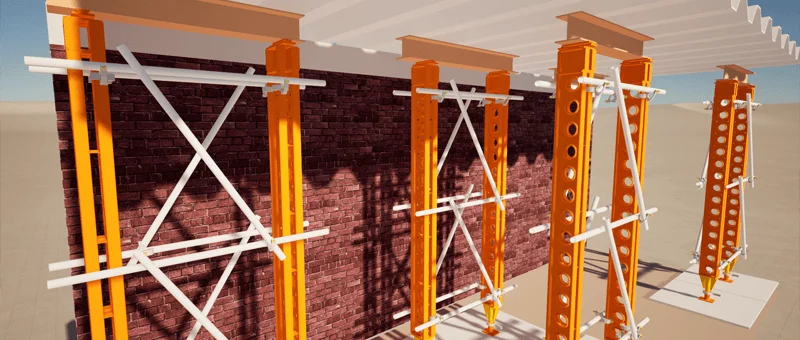
When and why you’d use it: a Form C is mandatory wherever the temporary works affect railway operations or could affect the public. Propping, falsework, piling mats, crane pads and facade retention all sit here, and each needs its own temporary works design, its own checker and its own certificate.
The common programme mistake is treating temporary works as a site problem to be picked up once the permanent design is signed off. They carry a full assurance chain of their own, so they need to be in the programme from the start, not discovered in it.
Form G: Combined Certificate for Category I Permanent Works
What it is: a combined design certificate covering Form A and Form B in a single submission. Where permanent works fall into Design Check Category I and are suitable for it, Form G rolls the Approval in Principle, the detailed design and the design check together.
What it contains: the design basis and assumptions, the detailed design, the calculations and drawings, and confirmation that the required design check has been carried out.
What comes out of it: combined acceptance of the design principles and the detailed design, plus a Physical Works Pricing Document to support instruction of the physical works.
When and why you’d use it: on permanent works where running a separate AIP and design certificate would add process without adding assurance. It removes a review round, and on an access-driven programme that is worth real time.
Form H: Category 0 Works
What it is: the simplified design and check route for Design Check Category 0 works. It exists so that simple, low-complexity works are not dragged through requirements built for far harder ones.
Where it applies: standard or established details, straightforward engineering works, and in particular anything covered by Network Rail Standard Design Drawings. In practice these are designs that can be verified by inspection or by simple engineering checks.
What comes out of it: formal acceptance of the Category 0 design and check. No calculations are required.
When and why you’d use it: when the works genuinely are simple. The judgement call is the category itself, not the paperwork. If there is any doubt that the works are Category 0, agree it with the Network Rail Asset Engineer before you commit to the route.
Other forms you're likely to meet
The A–H sequence isn’t the whole picture. Depending on the standard in use, you may also need:
- Departure / derogation applications - formal requests to deviate from a Network Rail standard, approved by the relevant Professional Head. These take time; identify them at AIP stage.
- Physical Works Pricing Document (PWPD) - produced alongside Form A and Form G. It is not a certificate, but it prices the physical works so Network Rail can decide whether to instruct the next stage, so in practice it governs whether the scheme moves.
- Options Study Report - the comparison of feasible solutions that should precede the AIP, with a budget estimate against each option.
- Design change certificates - for changes arising after the design has been certified.
- Interim or partial certificates - used on phased works where sections are handed back progressively.
How to Choose the Right Certification Route
The route follows the risk, not the fee value. Work through these questions early:
- Whose asset is affected? Network Rail permanent asset, third-party asset, or temporary works only? This determines whether you go via the project's engineering organisation or Asset Protection.
- Is it permanent or temporary? Both need assurance, but through different chains and different competent persons.
- What is the consequence of failure? Anything over, under or immediately adjacent to running lines pushes the check category up.
- How good is the existing information? Poor as-built records almost always mean survey work - LiDAR survey, structural inspection or intrusive investigation - before the design can be certified.
- Are departures from standards unavoidable? If yes, that becomes the critical path.
- Who signs? Confirm the named CRE and checker, and their acceptance by Network Rail, before you commit to dates.
How Matrix Handles Network Rail Approvals
We treat the certification chain as part of the design, not paperwork bolted on afterwards. In practice that means:
- A pre-AIP technical conversation. Before anything is drafted, we agree the likely design standards, check category and probable departures with the client’s engineering team. It’s a short meeting that routinely saves a month.
- Getting the baseline right. Rail assets rarely match their drawings. We use LiDAR and topographical survey, structural inspection and targeted site investigation to establish what is actually there, so the design assumptions are defensible under check.
- Writing AIPs to be approved, not to be commented on. A well-structured AIP states the assumption, cites the standard, evidences the justification and flags the departure. Reviewers can then say yes.
- Designing with the check in mind. Calculations are structured, referenced and traceable from the outset – because an independent Category 3 checker will ask for exactly that, and unpicking a disorganised model late is where programmes are lost.
- Supporting construction-stage certification. We stay involved through the works so that design changes, site queries and as-built variances are resolved and documented in real time, not reconstructed at handback.
- Being straight about what we don’t yet know. If the ground conditions or the hidden condition of a structure could change the answer, we say so early and price the investigation, rather than promising certainty we can’t deliver.
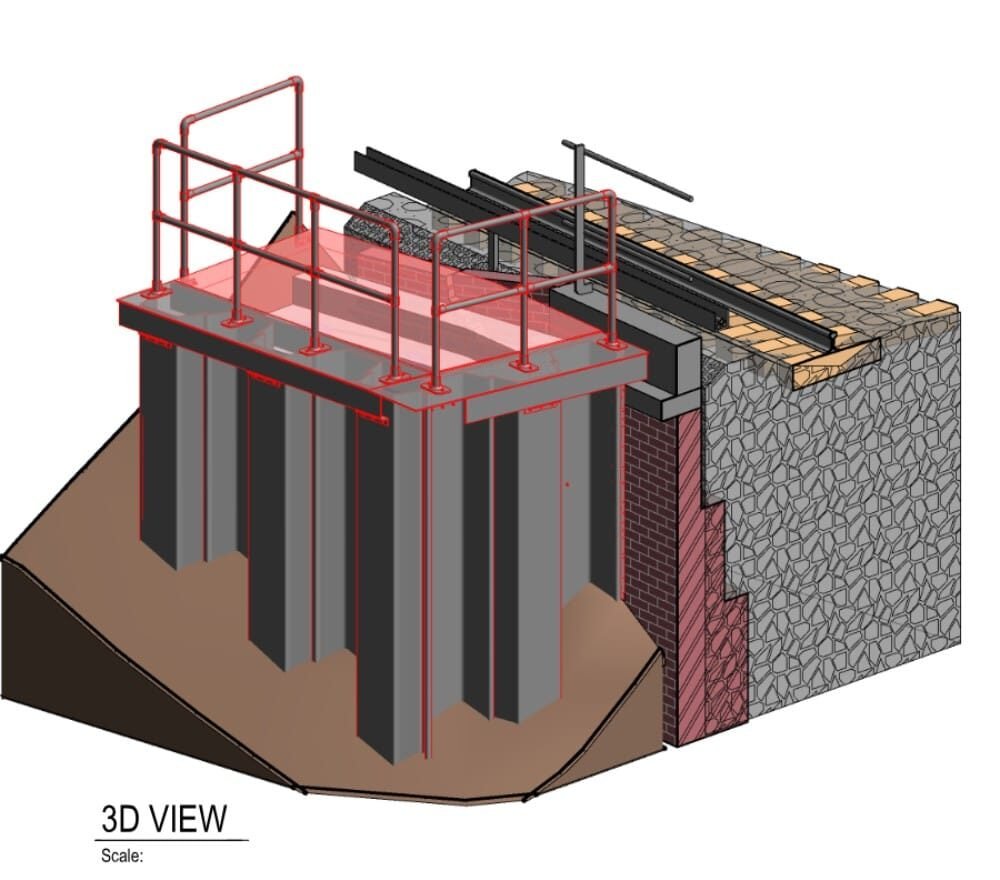
Our work spans bridge design, retaining walls, earthworks, drainage and structural steelwork, alongside temporary works, piling mat and crane mat design – so the permanent and temporary assurance chains can be coordinated rather than fought over.
Anonymised Case Study: A Twice-Rejected AIP
A Tier 1 contractor approached us after two unsuccessful AIP submissions for the strengthening of a masonry arch underbridge on a rural route. The possession was already booked.
The engineering was sound. The submission wasn’t. The condition data pre-dated recent deterioration, the assessment approach hadn’t been reconciled with the existing asset record, and two departures, headroom and drainage discharge, had been left as “to be confirmed”.
We carried out a fresh structural inspection with a LiDAR survey to establish accurate as-built geometry, rebuilt the assessment on that evidence, and rewrote the AIP with both departures fully argued and cross-referenced. The revised submission was accepted after a single round of comments. The Form B design and check package followed, and the works were delivered within the original possession strategy, though with a genuinely tight rather than comfortable margin.
The lesson: the approval process rewards evidence and clarity. It punishes optimism.
Frequently Asked Questions
How long does the Network Rail approval process take?
It depends on complexity, the quality of the submission and the reviewer’s workload. As a planning rule of thumb, allow several weeks per AIP review round and assume at least one round of comments. Departures from standards and Category 3 checks extend this. Anyone quoting you a guaranteed turnaround is guessing.
Do I need an AIP for minor works?
Often, yes, though genuinely simple works may fall into Design Check Category 0 and follow the simplified Form H route instead. Ask early rather than assuming; retrofitting an AIP is far more painful than raising one.
What is the difference between Form G and Forms A and B?
Form G is a combined certificate that covers both. Where permanent works fall into Design Check Category I and are suitable for the route, you make one submission covering the Approval in Principle, the detailed design and the design check, rather than two. It removes a review round. It does not lower the standard of assurance.
When can I use Form H?
Form H is the simplified design and check route for Design Check Category 0 works: simple, low-complexity designs, and in particular anything covered by Network Rail Standard Design Drawings. No calculations are required. The judgement to get right is the category rather than the form, so agree it with the Network Rail Asset Engineer before you plan around it.
Who can sign a Network Rail Design Certificate?
A suitably competent, named engineer acting in the relevant CRE role, accepted for that role on that project. Competence is assessed against the discipline and the complexity of the works, not simply seniority.
What's the difference between a design check and a peer review?
A peer review is advisory. A design check to a defined category is a formal assurance activity with a certificate and personal accountability attached. They are not interchangeable.
Do temporary works need Network Rail approval too?
Yes. Temporary works have their own certificate, Form C, and it is mandatory wherever they affect railway operations or could affect the public. Propping, falsework, piling mats, crane pads and facade retention all require their own designer, checker and certification chain, separate from the permanent works.
Where can I find the governing standards?
Network Rail standards are managed through the company’s standards catalogue, and industry-level standards are published via the RSSB Standards Catalogue. Access to Network Rail’s own documents is normally arranged through the project or Asset Protection team.
Talk to Us Before You Submit, Not After
The Network Rail approval process is navigable. It just isn’t forgiving of assumptions – and the cost of getting the assurance route wrong is almost always measured in lost access windows rather than lost drawing hours.
If you have a rail project at feasibility, an AIP that keeps coming back, or a possession date that depends on certification you haven’t yet scoped, we’re happy to look at it with you. A short conversation now is usually enough to identify the critical path.
Get in touch with the Matrix Consulting Engineers team to discuss your Network Rail approval strategy, design certification or independent check requirements.